About Split
About Split
Welcome to Split
The first inhabitant of Split was the Roman emperor Diocletian who started to build his palace in this friendly bay around 293 AD. After his abdication h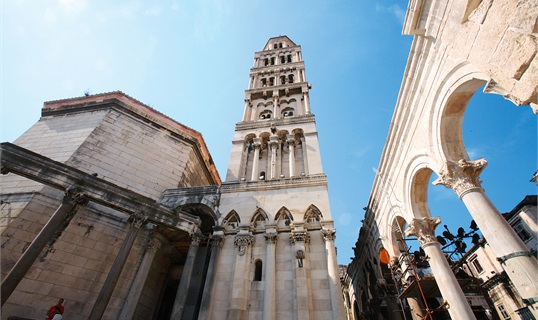 e withdrew to this luxurious palace of about 30 thousand square meters.
The following turbulent centuries made the palace into a town first populated by the citizens of the nearby Salona, fleeing before Avars and Slavs. The town overgrew the walls of the palace and its authorities kept changing - from Croatian kings in 10th century AD, Hungarian and Venetian administration, to French rulers and Austro-Hungarian monarchy.
Such past left its traces combined in the town everyday life. The city, however, went on remaining the centre of this part of the coast till our day. This mixture of historic layers brought some clumsiness and some things done too fast but today all that makes a part of its originality.
The big city today lives by the silent beats of history, lively spirit of the young and its particular Mediterranean charm.
Climate
The climate in the Split Region is typical Mediterranean.
Average daily temperature in April is approx. 15 °C and nightly temperature approx. 8-10 °C
Time Difference
Croatia is on Central European Time, one hour ahead of GMT . It observes Daylight Savings Time, so remains one hour ahead of the UK, and six hours ahead of New York, all year round.
Electricity
The electricity power supply in Croatia is 220 Volt and uses a
European standard plug of round 2-pin type.
Emergency Calls
The general emergency and assistance services are available on the
number 112.
Assistance on the roads: 1987
Information about local and district telephone numbers: 11888
Information about International telephone numbers: 11802
Weather forecast and road conditions: 18166
Telephone & Mobile Phones
International dialling prefix for Croatia: ++385
In Croatia, mobile phones use the frequency bands GSM–900
and GSM–1800. As a courtesy to other participants, please
turn off your mobile phone when entering any of the meeting rooms.
Credit Cards
All major credit cards are accepted in hotels and ATM s are available.
Banks/ATM machines
Banks are generally open Monday through Friday, 7:30 – 19:00
and are closed on Saturdays, Sundays and holidays. Closest ATM machine is available at Le Méridien Lav hotel.
Currency Exchange
The official currency in Croatia is Kuna (HRK). Kuna notes are issued in denominations of 10, 20, 50, 100, 200, 500 and 1000. Coins come in denominations of 1, 2 & 5 Kuna and 50, 20, 10, 5, 2 and 1 lipa pieces.
Exchange can be carried out in banks, exchange offices, post offices and most hotels.
Transportation
Public bus transportation is available from Split to Podstrana and Conference Venue. Please, check timetable.
Line 60 (Split-Omiš) takes you from Split center to Le Méridien Lav hotel (Conference Venue) and back. Ticket price in one way (available in the bus) is HRK 13,00 (EUR 1,75).
Taxi is about 150 HRK (20 EUR ).
Additional information is available at the info desk.
Airport
Kaštela SPU International airport is located 28 km (25 minutes highway drive) from the Le Méridien
Lav hotel. Taxi is about 400 HRK (54 EUR ).
Restaurants in Split
Restaurants in Split offer various types of cuisine, from traditional to international.
Shopping
Stores located in the old city are open mostly from 09:00-20:00 from Monday-Sunday.
How to get to Split
By bus
The bus station of Split is located in the very centre of the city, right next to city harbour and railway station. There are regular bus lines to and from Munich and Trieste. Most other bus lines involve a change in Zagreb. There are many buses to and from Zagreb every day. The journey takes between 5 and 7 hours (depending on the line and carrier). For more information, see the websites of the bus stations in Split and Zagreb.
On most intercity buses you pay a fee for luggage. This fee of about 1€ per piece of luggage is paid to the driver upon boarding.
By train
Split train station is right in the city centre, it is a few minutes walk from the port and from the old town. The train station is rather basic, because train travel is not much used to Split.
It is possible to travel by train to Split from elsewhere in Europe, although the majority of routes involve a change of trains at Zagreb. There are regular lines to and from Zagreb, which take 6-9 hours depending on the line. Timetables can be found from the Croatian Railways website.
By car
You can reach the city of Split from various directions:
• From Zagreb by Highway A1 Zagreb-Split,
• or using the road through the inland (Zagreb - Karlovac - National Park Plitvicka jezera- Knin - Sinj - Split)
• traveling along the Adriatic coast from the north (Rijeka - Zadar - Šibenik - Split)
By plane
Split Airport is, after Zagreb Airport, the most important in Croatia. Scheduled services fly to major European cities, with summer charter flights from more. The airport is about 25 km west from Split, near the city of Trogir. For more information visit the Split airport website.
If leaving Split by plane, be careful to plan the journey to the airport in advance, as local buses don't run before 5 AM or after midnight.
Other airports: Zadar (160 km, regular bus service to Split) Zagreb (400 km, regular train, bus and plane service to Split)
Getting to town from airport
Public Transport
At Split Airport there is a bus stop. Lines No. 37 (Split – Trogir; Trogir – Split) and No. 38 (Split Airport – Kastel Stari – Split; Split – Kastel Stari – Split Airport).
Local buses run from the road outside the terminal - walk through the parking lot and go to the bus stop on the other side of the road.
Taxi
Taxis are available outside the terminal building at all times during airport operating hours.
A taxi to Split centre (ferry port or Diocletian's Palace) takes a bit over 30 min and costs about 270 kn (35 EUR) on the meter, though most drivers will agree on 220 (29 EUR) if asked in advance.